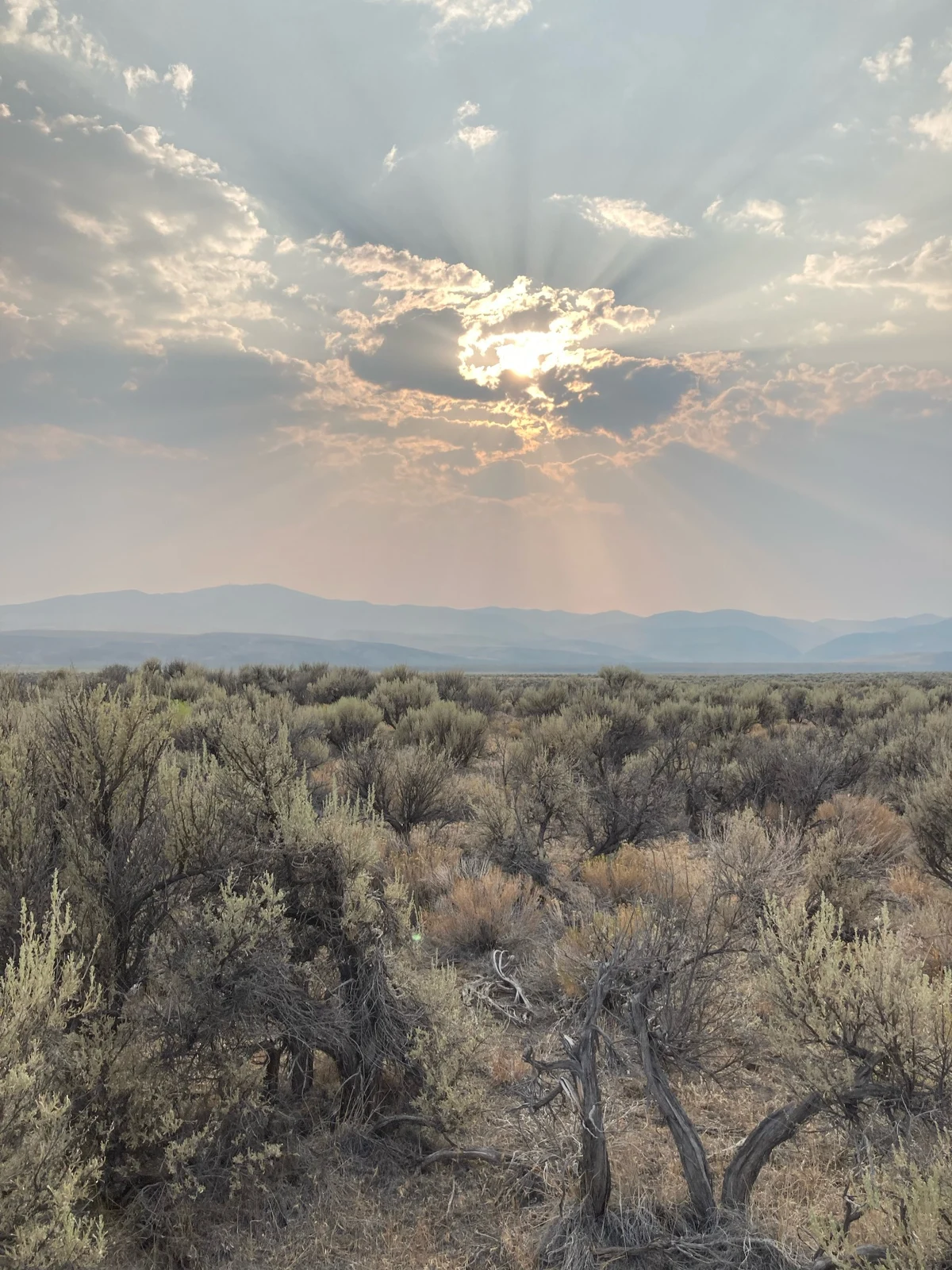
The sagebrush ecosystem provides critical habitat for declining species and supports extensive cultural, ecological, and economic values. The sagebrush steppe, which once occupied over 200 million acres across North America, has been dramatically reduced by natural and anthropogenic stressors to approximately 115 million acres. Big sagebrush (Artemisia tridentata) serves as the cornerstone of this ecosystem, dominating arid landscapes across western North America. The A. tridentata species complex includes three subspecies that differ in ploidy level and ecological niche, often occurring in close proximity while occupying different environments across gradients in elevation and climate.
Our study used a comprehensive landscape genomic dataset of 627 plants from 64 populations sampled across the geographic and environmental ranges of the A. tridentata subspecies. We characterized patterns of genetic differentiation among the three subspecies to evaluate the extent of their divergence and assessed how variation in ploidy may influence divergence and gene flow. Understanding these patterns and processes can inform ecological restoration and our expectations for how sagebrush populations may respond to changing environments across western North America.
Despite co-occurring across the landscape, subspecies form distinct evolutionary lineages
The three most widespread subspecies within A. tridentata are basin big sagebrush (A. tridentata ssp. tridentata), Wyoming big sagebrush (A. t. ssp. wyomingensis), and mountain big sagebrush (A. t. ssp. vaseyana). Our previous work (Massatti, Faske et al., 2025) highlighted divergence between A. t. tridentata and A. t. vaseyana, with limited gene flow occurring in environmentally predictable parts of the landscape. This study extends that work by incorporating range-wide sampling and including A. t. wyomingensis.
We show substantial genetic differentiation among the three subspecies, with limited evidence of gene flow, even though their geographic distributions overlap extensively. Perhaps the most striking evidence of this pattern is that genetic differentiation can be greater between subspecies occurring within 1 km of each other than between populations of the same subspecies separated by more than 1,000 km. We also show that, despite this geographic overlap, genetic differentiation among subspecies is associated with adaptation to different environmental conditions. The predictability of these adaptive patterns within and among subspecies creates an opportunity to inform management decisions at landscape scales.
Polyploidy, a driver of divergence
Environmental adaptation is not the only driver of divergence among the subspecies; variation in ploidy level may also create a barrier to successful mating. Polyploidy, or having multiple sets of chromosomes, has dramatically influenced the evolutionary history of plants. Polyploidization is common in the genus Artemisia, and in A. tridentata, ploidy differences occur both among and within subspecies: A. t. tridentata is diploid (2x), A. t. wyomingensis is tetraploid (4x), and A. t. vaseyana is mostly diploid (2x) but can also be tetraploid (4x).
Our results highlight the role of ploidy in differentiation among the subspecies. We found strong genetic separation between diploid A. t. tridentata and A. t. vaseyana and tetraploid A. t. wyomingensis, providing evidence that differences in ploidy may act as a reproductive barrier. Where we do see gene flow, it primarily occurs between subspecies with the same ploidy level. For example, previously documented gene flow between diploid populations of A. t. tridentata and A. t. vaseyana is evident. Our study also highlights gene flow between tetraploid populations of A. t. vaseyana and A. t. wyomingensis.
Implications for restoration across the West
Our findings show that subspecies identity, ploidy level, and environmental adaptation all contribute to how genetic variation is structured across the landscape. These differences should therefore be considered when selecting, producing, and deploying plant materials for restoration. This may be particularly important where subspecies occur together or are difficult to distinguish, because moving seed across subspecies or ploidy levels could introduce plant materials with different environmental adaptations or reproductive compatibility.
At the same time, gene flow among subspecies is a natural part of the evolutionary history of big sagebrush. Our previous work shows that hybridization can occur in predictable parts of the landscape, and the current study further demonstrates that ploidy helps determine where that exchange is possible. Together, these findings suggest that restoration strategies should consider subspecies identity, ploidy, geography, and environment rather than treating each factor independently. Because these genetic and adaptive patterns are predictable across large geographic regions, they also provide an opportunity to translate genomic information into landscape-scale tools that can help guide seed sourcing and restoration planning.
References
Massatti R*, Faske TM*, Barnes IM, Leger EA, Parchman TL, Richardson BA, Knowles LL. (2025) Suturing fragmented landscapes: Mosaic hybrid zones in plants may facilitate ecosystem resiliency. Proceedings of the National Academy of Sciences, 122(31), e2410941122. doi: 10.1073/pnas.2410941122
Faske TM, Agneray AC, Osuna-Mascaro C, Jahner JP, Massatti R, Richardson BA, Leger EA, Parchman TL (In review) Polyploidy and environment adaptation structures divergence and limited gene flow among sympatric subspecies of big sagebrush (Artemisia tridentata).