Healthy ecosystems depend on native plants, but the U.S. still lacks enough high-quality native seed to meet growing restoration needs. Federal programs have spent more than 20 years working to improve native seed collection, farming, and use by bringing together land managers, scientists, and seed growers.
Federal programs, especially those coordinated by the Bureau of Land Management Plant Conservation and Restoration Program, have expanded the national seed supply and created tools that help people choose the right species and seed sources for different environments. However, major challenges remain, including unpredictable seed demand, changing climatic conditions, and gaps in knowledge on how seeds grow under farming and restoration conditions.
Stronger partnerships, better monitoring, and new decision-making tools can help land stewards more effectively restore damaged landscapes and support resilient plant communities.
Perspective article
Integrating Science and Management to Improve Seed-Based Restoration
Shriver L.C., Huxley J.D., Jordan S.E., Symstad A.J., DeFalco L.A., Bradford J.B., Esque T.C., Mengelt C., Munson S.M., Barga S.C., Kilkenny F.F., Kindred J., Kulpa S.M., Perkins J.L., Pilmanis A.M., Edwards F.S., Agneray A.C., Butterfield B.J., Faist A.M., Gaddis M., Garbowski M., Goebl A.M., Larson J.E., Benkendorf R.C., Shryock D.F., Slate M.L., Vandergast A.G., Woolridge C.B., Massatti R. 2026. Ecological Restoration.
Abstract
Native plant seed is essential for restoring healthy, resilient ecosystems in an era of global degradation and change. In the United States, federal agencies bolster the availability of native seed by coordinating seed collection, agricultural production, and use in restoration and reclamation with a broad network of federal and non-federal partners. As a result, the native seed supply has greatly expanded, but challenges and knowledge gaps remain for effective native seed development and use.
To address this need, the article synthesizes lessons learned from more than 20 years of experience across federally organized native plant programs engaged in developing and using native seed. It also identifies strategic research directions to ensure that restoration can meet challenges imposed by future land disturbance and other stressors, with a focus on Bureau of Land Management Ecoregional Native Plant Programs.
The synthesis shows that sustained partnerships are essential for connecting the complex network of land managers, researchers, and seed growers needed to develop seed resources, guidance, and decision-support tools. It also highlights critical knowledge and technology gaps that constrain efforts to maintain ecosystem resilience. Integrating these research themes into restoration treatments and native seed production could help address uncertainty in native seed production and use.
Restoration recap
- Long-standing federal native plant programs provide lessons and future research directions that support the National Seed Strategy for Rehabilitation and Restoration in the U.S.
- Close collaboration among land managers and researchers has produced science-based guidance and decision-support tools for seed selection, seed production, restoration, and reclamation.
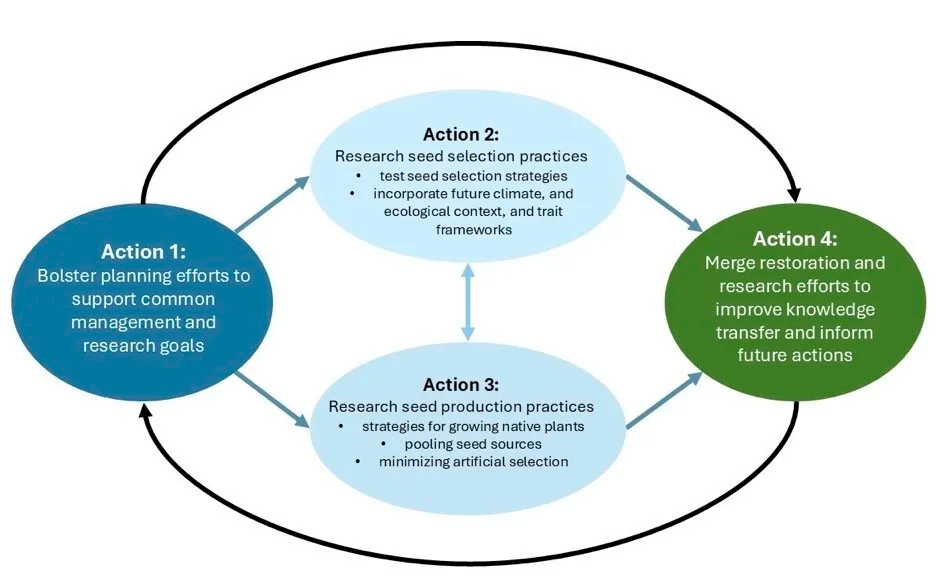
- Future research should address seed sourcing approaches, climate variability, ecological community interactions, seed production techniques, restoration methods, and decision-support tools.
- Restoration practice can benefit from standardized monitoring, nationally coordinated data collection and storage, and sustained synthesis to update best management practices.
- Federal native plant programs provide science and tools available to partners across organizational scales and offer a blueprint for interdisciplinary collaboration.