
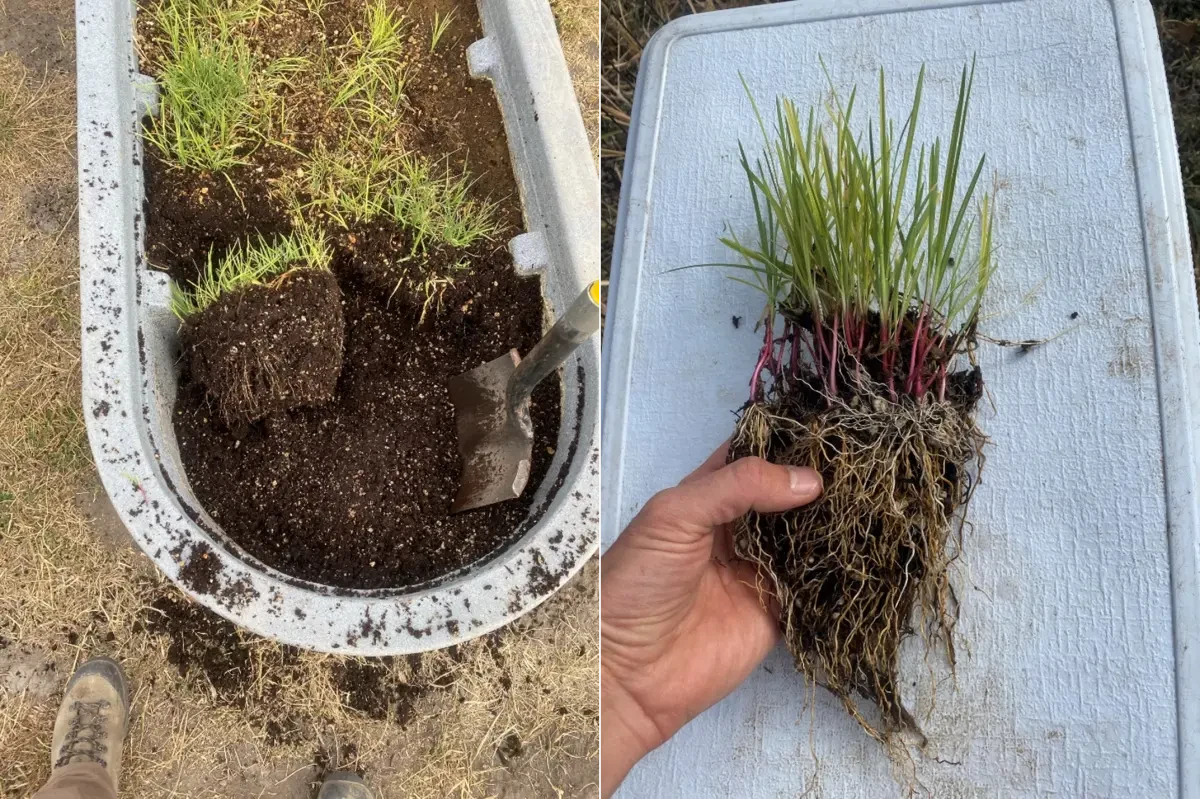
Establishing a rare plant at additional sites can help spread the risk of losing it to habitat damage or other threats. But the number of plants growing at a new site tells only part of the story. Conservation also depends on how well those plants represent the diversity found in the wild.
Our study in Evolutionary Applications examined this question in Oregon semaphore grass (Pleuropogon oregonus), a rare grass found only in eastern Oregon. Conservation partners have established new populations using divisions of existing plants, an approach known as vegetative propagation. We asked whether these efforts preserved the diversity of their source populations and what the species’ history could tell us about future conservation decisions.
Many shoots can belong to the same individual
Like many wetland plants, Oregon semaphore grass can spread through clonal growth, producing new shoots that are copies of an existing plant. A patch with many shoots may therefore contain relatively few genetically distinct individuals. This makes it difficult to judge diversity by appearance or plant counts alone.
By comparing DNA from natural and introduced populations, we found that introductions from the northern region retained diversity comparable to their sources and included multiple distinct individuals. An introduction from a southern source with little diversity reflected that same limitation. Vegetative propagation had preserved the diversity collected, but it could not supply variation absent from the source material.
Population history matters when choosing sources
The study also identified two strongly distinct lineages corresponding to the species’ northern and southern regions. Analyses of their history indicated a long period of separation with limited exchange between them.
That history warrants care when considering whether to mix plants from the two regions. The study did not directly test whether mixing would improve or reduce plant performance, so its benefits and risks remain uncertain. Decisions about moving plants benefit from considering this history alongside habitat conditions, reproduction, and the purpose of the conservation effort.
What this means for conservation
The findings support vegetative propagation as a useful way to preserve diversity in rare clonal plants when collections represent multiple distinct individuals. Collecting across a source population, rather than concentrating on a small patch, may improve the chance of capturing that diversity. Comparing source and introduced populations can then help managers evaluate what an introduction has retained.
Preserving existing diversity is one part of supporting long-term persistence. Clonal growth can maintain established plants, while sexual reproduction can generate new combinations of inherited variation. Continued attention to habitat, reproduction, and population diversity can help conservation partners evaluate whether introduced populations are meeting their goals over time.
Research article
Massatti R., Bainbridge S., Copeland S.M., Crouch C., Faske T.M., Hamerlynck E.P., Palmer B., and Roybal C.M. (2026). Evolutionary Applications, 19, e70299.